
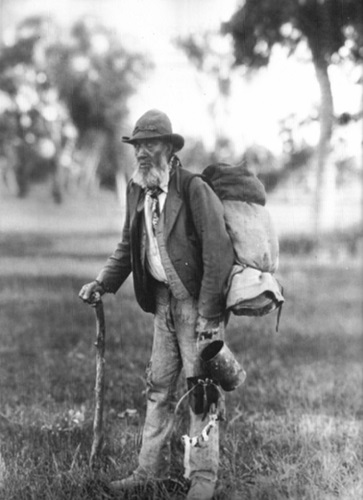
The life of the swagman in Australia has long been romanticised through the famous ballad, Waltzing Matilda. Almost our unofficial anthem, Waltzing Matilda, celebrates the life of a man down on his luck (the swagman or swaggy), who decides to steal a sheep (jumbuck) from a rich farmer (squatter). The underdog has always been popular in Aus.
For the uninitiated, a swaggy was a man who had left home, predominantly in search of work. Often living a true hand-to-mouth existence, these men walked huge distances throughout rural Australia, knocking on farm doors, seeking food, work or both.
The term ‘swaggy’ referred to the swag that they carried strapped to their backs. The swag may have included an old blanket, wrapped in a strip of canvas that was then wrapped around any bare necessities they were carrying.
Rather than Waltzing Matilda, in reality the life of a swaggy was often cold, hard and hungry.

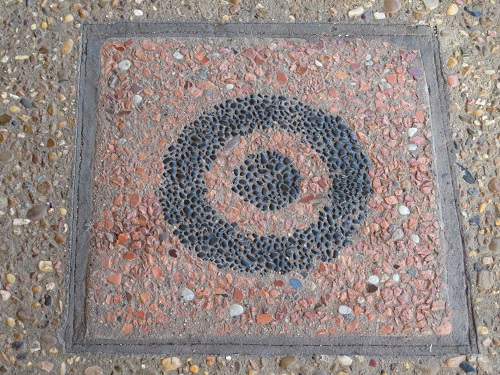
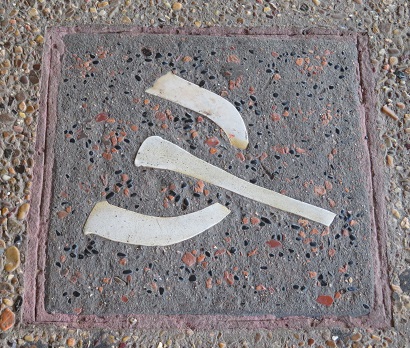
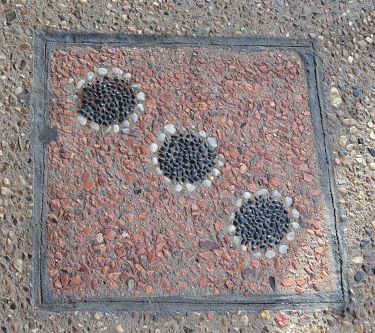
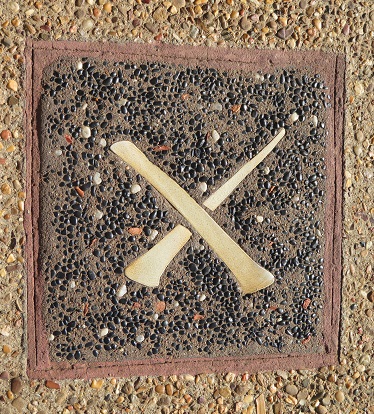
The historic town of Gulgong in Central West NSW has taken swaggy folklore and literally embedded it in the town. As you stroll the original goldrush-era streets, and if you are observant, you will notice some interesting signs displayed underfoot.
You see, with so many swaggys wandering around the countryside, a bush telegraph soon developed, communicating a whole range of key information. This era is long before any sort of widespread telecommunications and swaggys had to rely on the materials they had to hand – a stick and a clear patch of dirt – to leave their messages for others following in their footsteps.

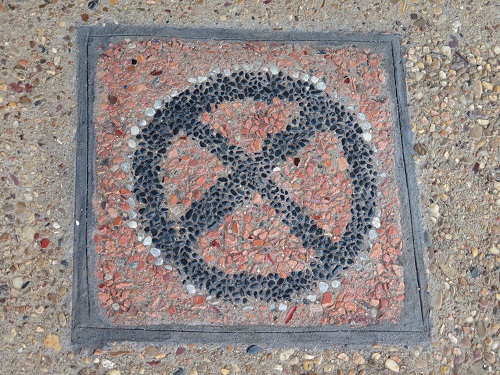
Near the entrance to a farm or other property, a descriptive symbol would be subtly drawn in the dirt to forewarn the next caller. With these simple scratches, the men would share all sorts of valuable information such as ‘a good place for a handout’ or ‘angry dogs’.
Using the skills of Master Potter, Chester Nealie, examples of swaggy symbols are displayed intermittently along Gulgong’s Mayne Street. I wondered how many times I had walked along that street and had never looked down to see them.
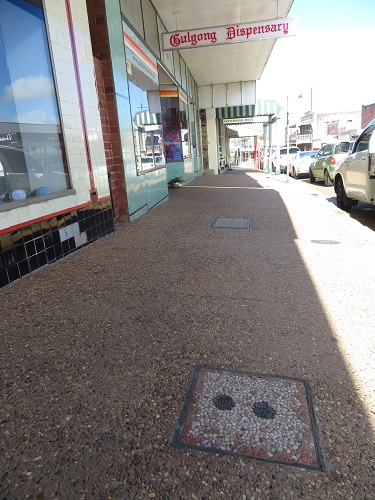
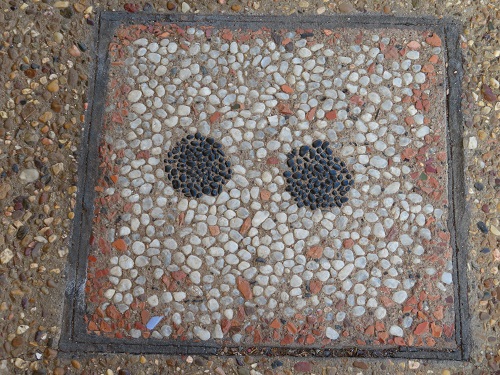
While Waltzing Matilda dates from 1895, I spoke to my parents the other day to see if they recall swaggys calling into their farms. Both Mum and Dad would have been very young children during the post-Depression years of the 1930’s and while Dad can’t recall any swaggy visits, Mum remembers a strange man coming to the house and chopping wood. In return he received some cooked mutton (mutton was a staple in their house in lean times) and bread before walking off down the road again.

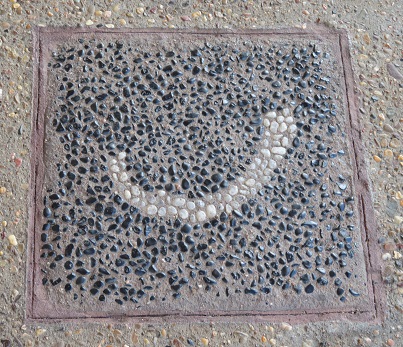
While the pavement tiles are only a small thing, they do add to the overall historic narrative of Gulgong. Gold was found in Gulgong in the early 1870s and I have no doubt that the booming region attracted its fair share of swaggys trying to turn their lives around. Perhaps their experience on the road stood them in good stead when bust times came and it was time to return to the wallaby track again.

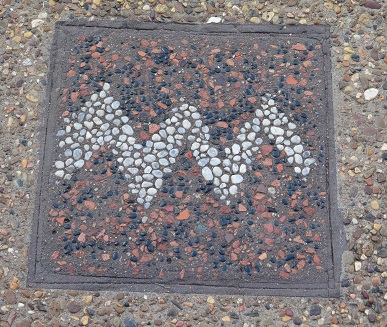
This short stroll really tweaked my interest in this Aussie phenomenon. I disappeared down a couple of internet rabbit holes and it triggered some great conversations and memories.
Congratulations to the Gulgong community for bringing history to life.
Did you have swaggys, or the equivalent, in your country?
The Basics

What: Grab a copy of a small map describing the Gulgong Symbol Trail from the Holtermann Museum.
Where: Start from the intersection of Medley and Mayne Street, Gulgong and wander up the street for about 200m.
When: Much of the trail is under the cover of shop awnings fronting Mayne Street and you could comfortably stroll the street in any weather.
Why: To be intrigued by the imagery and insight into times long past.
How: On foot is best.
Who: Generally the foot path is in good condition and would be accessible by history buffs of all ages.
Related Posts: To see why I keep rabbiting on about gold rush history, check out my post describing the Holtermann Museum. It’s a cracker.
Related Blogs: For a completely different stroll, join Jo on her Monday walk as she wanders through gorgeous coastal Portugal.
Read About It: And for an armchair stroll through the Aussie bush with the smell of eucalyptus in the air and a swag on your back, grab a copy of D’Arcy Niland’s The Shiralee. Go straight to Book Depository.






#gulgong #travelinspo #swagman #holtermannmuseum #australianhistory #hardtimes #history #visitmudgeeregion #bushtelegraph #swaggysymbols #shortwalks #waltzingmatilda #whattodoingulgong
 Life...one big adventure
We’ve been through Gulgong a few times and never noticed the signs. Will have to check them out next time, once we can leave home, currently flooded in.
LikeLiked by 1 person
Me too! I live just down the road and it wasn’t until I picked up the brochure from the Holtermann Museum that I knew they existed! It pays to look down. Stay safe. You guys are copping it at the moment!
LikeLiked by 2 people
What a wonderful ‘shorthand’, Mel! I wonder how they devised it? It must have been refined over time. I’d do badly as a swaggy. I’ve never been one for knocking on doors. Good to preserve a little history in this way. Thanks a load for thinking of me.
LikeLiked by 1 person
I guess desperation makes you do things you would not normally stoop too. I would make a lousy beggar too, but then I have never needed to try my luck. Thank Goodness! 😉
LikeLiked by 1 person
This is fascinating. And so good that Gulgong has recorded this important part of Australia’s social history before it goes AWOL.
LikeLiked by 2 people
I’m with you. It’s important to preserve the stories from past, much tougher times. It makes me appreciate all that we have today.
LikeLiked by 1 person
This is fascinating – what a great way to commemorate this piece of social history!
LikeLiked by 1 person
I guess today’s equivalent would be emojis, but I can’t see us scratching them into the dirt OR having to wander around the countryside. 🙂
LikeLiked by 1 person
😂
LikeLiked by 1 person
I know the song quite well, but had no idea of this meaning. I thought it was about Gallipoli. Sounds like an interesting place embracing their history. Maggie
LikeLiked by 1 person
Oh I just realized, it’s the Pogues Walzing Matilda song that is about Gallipoli! Haha, I do know both songs, but still didn’t know it was about swaggys 🙂
LikeLiked by 1 person
🙂 – The Pogues singing our Waltzing Matilda! Certainly more upbeat!! 🙂
LikeLike
🤣🤣
LikeLiked by 1 person
Thanks, Maggie. This one pre-dates Gallipoli by about 35 years.
LikeLike
A wonderful stroll through time and history, thank you for sharing!
LikeLiked by 1 person
My pleasure – thanks for wandering along…
LikeLiked by 1 person
Great post, I had not heard of this term, so have learnt something new today. Those symbols are very artistic
LikeLiked by 1 person
As the old saying goes… ‘you learn something every day and it is a dull day when you don’t’! 🙂
LikeLike
Always something on WordPress 😊
LikeLiked by 1 person
True!
LikeLike
What a fascinating bit of history. Thanks for sharing.
LikeLiked by 1 person
My pleasure. I love a bit of quirky history.
LikeLiked by 1 person