
The ‘Wilds of Borneo’ is a well-used saying to describe some place thickly jungled and pretty inaccessible. Unfortunately today, much of the wilds of Borneo have been cleared, flattened and planted with endless rows of palm oil trees.
Travelling along the main roads, the plantings start almost on the very edge of the road and stretch up over the hills, and to the horizon beyond. This solid block of mono-culture is hard on the eye that has become accustomed to the lushness and unbridled rampantness (Yep, that’s a new word) of the native jungle.
It is even harder on animals like sun bears who are dislocated from their homes or killed as the bulldozers and excavators wreak havoc.

The Borneo Sun Bear Conservation Centre was established to care for and protect orphan sun bears and rescue those that had been cruelly captured as pets. Sun bears are the smallest bears in the World and I guess it is these ‘small’ and ‘cute’ factors that have worked against them, tempting humans to steal the young cubs from their mothers. Both habitat destruction and other negative human impacts have drastically reduced the number of sun bears still found in the wild.
Established in 2008 by Dr (Hon) Wong Siew Te, D. J. N, “…has been studying and working on the ecological conservation of the sun bear since 1998. His pioneer studies of sun bears in the Bornean rainforest have taken him into the most threatened wildlife habitat on Earth, where field work is exceedingly difficult.
Witness to many captive bears – cubs and adults – kept in small cages, unhygienic and often disgusting conditions in zoos, farms, private menageries, and private homes – almost all of them suffering from serious stereotypic behaviours: relentless pacing and circling, obsessive licking and other disturbing behaviours.
Seeing sun bears in these dreadful captive conditions combined with his animal welfare and veterinary education and his love for sun bears, Wong was inspired to set up the Bornean Sun Bear Conservation Centre.” Source.
Personally, I knew very little about sun bears before visiting the Centre and had quite low expectations of what we would see. I think that was a useful frame of mind to have as my visit was a very different experience to say, the visit to the Proboscis Sanctuary.
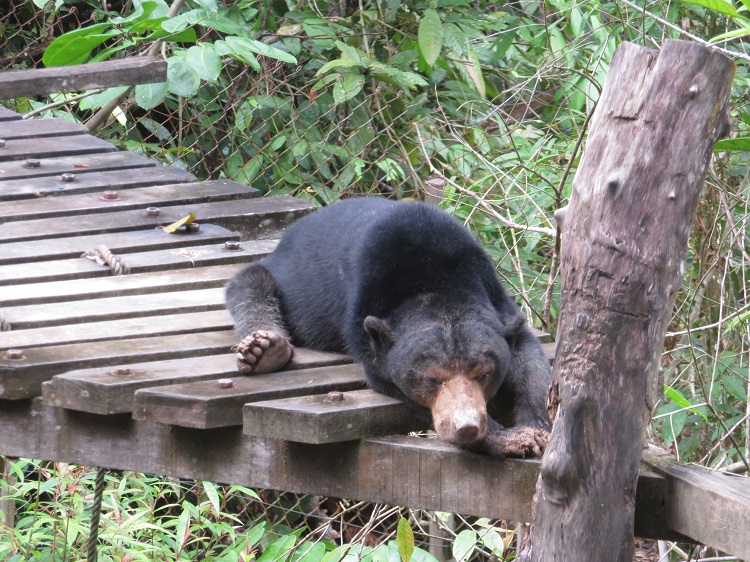
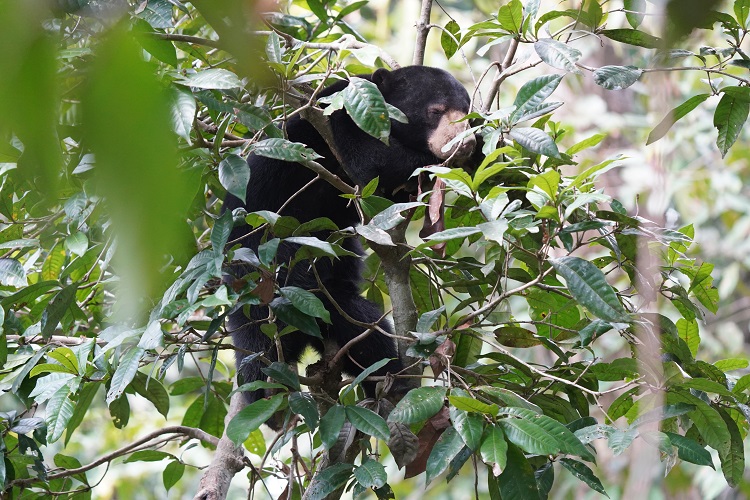


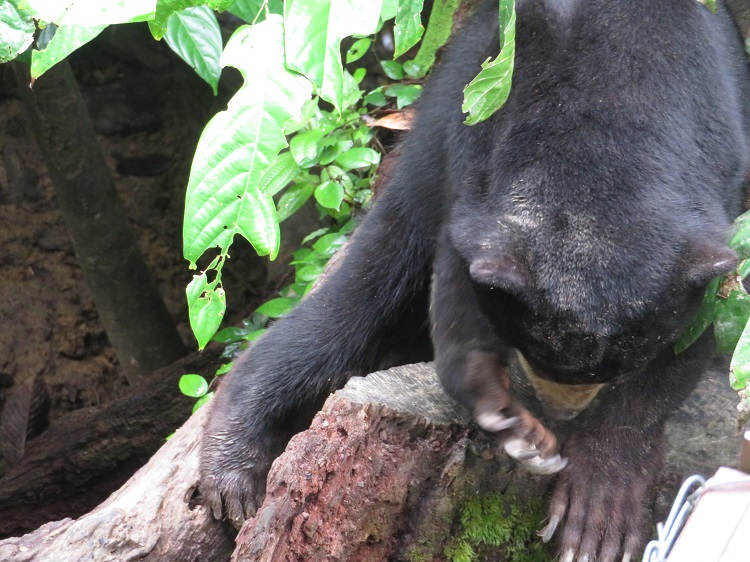
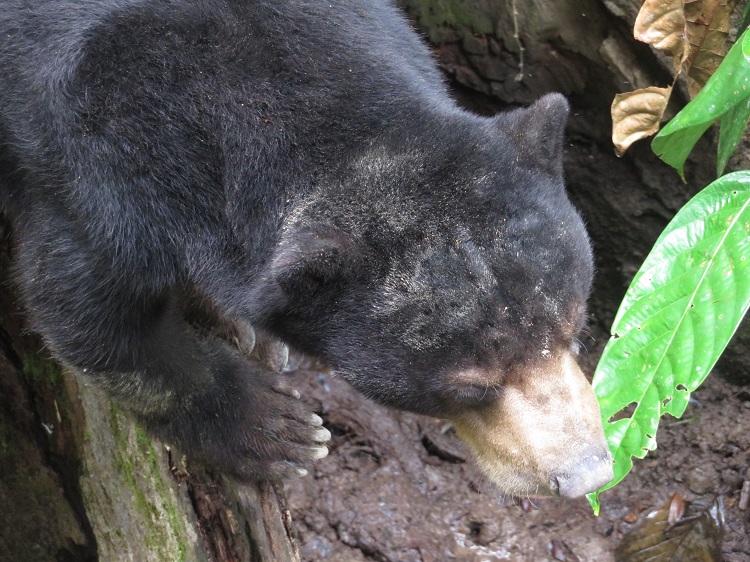
For one thing, it is very quiet and that means quiet on every level. The crowds are smaller and they walk calmly on the raised boardwalks to and from the various viewing platforms. The jungle seemed quiet too with very little birdlife or movement of any kind and finally, the sun bears are extremely quiet and if you see one that’s awake, you are doing well.
Maybe it is the nature of bears in general, but it appears that they sleep A LOT! If they are not sleeping, they are sitting staring off into space or standing on a log, lifting their noses to the breeze.


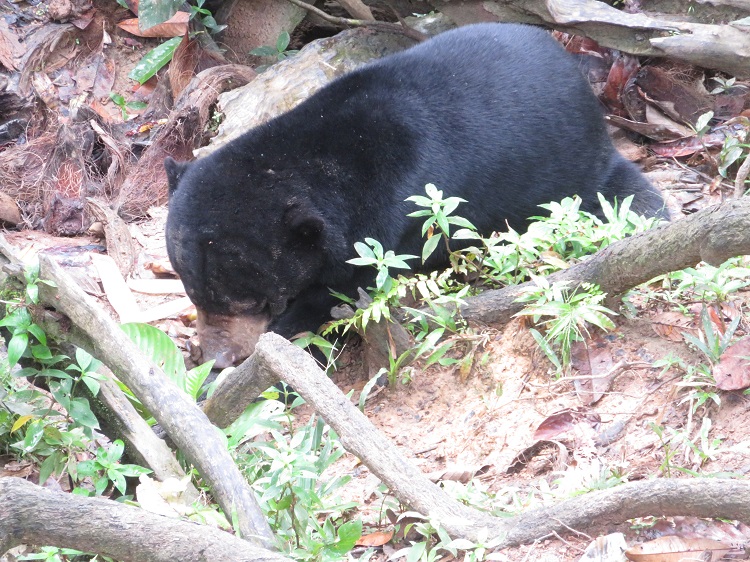
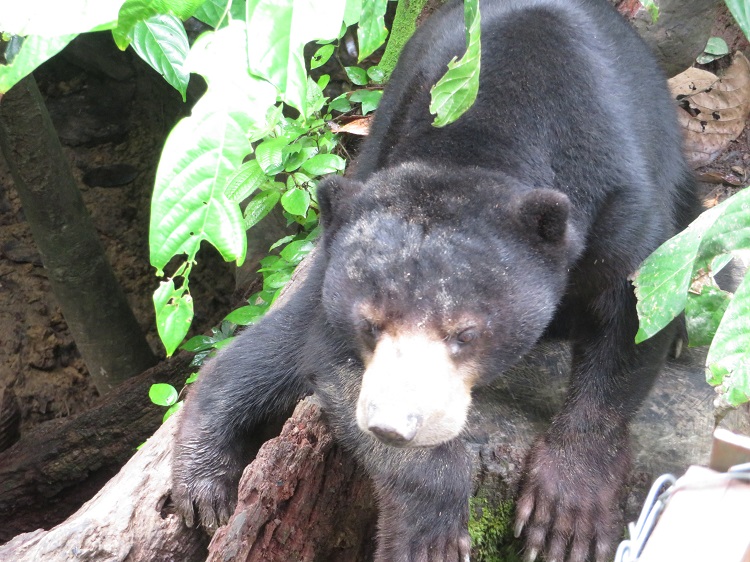
A rather obvious thing to say, but the Conservation Centre is a great place to learn about the lot of the sun bear. There are a large number of interpretative signs explaining the bear’s life cycle, habitat and even their individual personalities. In the Information Centre, it is useful to watch a short video to understand the Centre’s development, its aims and objectives.
It was super-hot and steamy as we strolled the boardwalks and maybe that explained some of the bear’s lethargy. At one viewing platform a sun bear relaxed on a ledge, just chilling. At another location, a sun bear nosed about as it balanced on a log and maybe it was us that it was smelling. The last one we saw was spread-eagled, fast asleep. It didn’t look like the most comfortable position, but then I’m not a sun bear.


It’s hard to believe, but the heat was becoming even more oppressive and it seemed to be sucking all the oxygen out of the air, at the same time as drenching us with sweat. With a huge rumble of thunder, the skies opened dropping great, fat droplets on us and the steaming jungle. I was caught between wanting to stand in the instant coolness of the storm and yet not wanting to get drenched. I met both urges halfway and enjoyed the feel of the rain on my skin before bolting inside the Information Centre.
I wonder where the sun bears found protection from the storm? Or did it even wake them up? What a fabulous learning opportunity this visit has been. Both eyes and minds wide open.

When did you last learn something amazing?
The Basics
What: It costs around AUD$20 for International visitors to enter the Centre. There is also a significant fee for DSLR cameras with lenses over 500mm long. A comprehensive souvenir shop awaits you on your exit.
Where: The Centre is located adjacent to the Sepilok Orangutan Sanctuary at W.D.T. 200, Sabah Wildlife Department, Jalan Sepilok, Sepilok, 90000 Sandakan, Sabah
When: The Centre is open 9am-330pm every day.
Why: To learn a whole lot about this little and little-known bear.
How: I did not see any public transport servicing this destination, but apparently public buses do run a few times a day. Otherwise, you will need to arrange private transport or join a tour.
Who: This tourist attraction will appeal to visitors of all ages, although children may find it all a little tame.
Related Posts: We didn’t spot any sun bears on our visit to the Kinabatangan River, but we did enjoy all the lush jungle.
Related Blogs: If you fancy volunteering at the Sun Bear Centre, then you can read about other volunteer’s experiences here.
Read About it: For a more detailed read about sun bears and how the Centre developed, grab a copy of Saving The Sun Bears by Dr Sarah Pye. Available from Fishpond.
We visited the Sun Bear Conservation Centre in early March 2023.


#sabah #sunbears #worldssmallestbear #travelinspo #Sepilok #Sandakan #wildlife #animalsanctuaries #animalconservation #bsbcc #Borneo #feedingtime #Borneosunbearconservationcentre #sleepytime
 Life...one big adventure
I’d love to see a sun bear 👍
LikeLiked by 1 person
Well, now you know where to find them! 🙂
LikeLiked by 1 person
I’ve known all along.. it’s finding time and funds to do it! 😁
LikeLiked by 1 person
Ah, Yes. There are always those challenges! 🙂
LikeLiked by 1 person
When the weather is that hot and humid I reckon I’d be pretty lethargic too. Cheers
LikeLiked by 1 person
True! 🙂
LikeLike
Especially when you are wearing a fur coat!
LikeLiked by 1 person
How very interesting…and sad at the same time. I hate what we humans do sometimes.
LikeLiked by 1 person
Agreed. In most cases, ‘it’s all about us’. 😦
LikeLiked by 1 person
I confess, I’d never even heard of sun bears, Mel. It seems they’ve had a pretty rough deal.
LikeLiked by 1 person
Yes, and we humans haven’t changed our ways, have we?
LikeLike
Not a bit!
LikeLiked by 1 person
Amazing animals 🙂
LikeLiked by 1 person
Definitely. Not the most energetic and entertaining, but at least we know they are safe now.
LikeLike
I have never heard of sun bears. But am surprised to see how they can sleep so comfortably in a tree (or anywhere else for that matter). They seem very relaxed – maybe we humans can learn something from them 😉.
LikeLiked by 1 person
Definitely!
LikeLiked by 1 person
We saw sun bears at a sanctuary in Cambodia a few years ago. I’d never heard of them before.
LikeLiked by 1 person
I think I had heard of them, but didn’t know they were just as threatened as the orangutans. We humans just never seem to learn.
LikeLiked by 1 person
Often it’s disappointing to see creatures during the day when they want to sleep off the heat. I remember seeing lethargic looking kangaroos in Australia and were told it was the hottest time and they would be more active later.
LikeLiked by 1 person
Definitely. I am the same! Much more active in the early morning, 😁
LikeLiked by 1 person