Heading to the metropolis of Melbourne, I knew I wanted to get a dose of culture. I wanted to see amazing artworks displaying skill and passion for the subject, and I found that in spades at the National Gallery of Victoria (NGV) Ian Potter Gallery.
As I’ve said many times before, I don’t have an artistic bone in my body. Being devoid of talent makes me appreciate the talent of others and what they produce…even if I don’t understand it.
Luckily for me, our visit to Melbourne coincided with an exhibition of distinctive watercolours by a number of Aboriginal artists from the Hermannsburg Mission (Ntaria) in Central Australia.
With memories of my own Central Australian adventure along the Larapinta Trail still fresh in my mind, this exhibition was high on my list of must-do Melbourne activities.
Join me for a gentle wander through Arrernte country.


NB: Apologies for the quality of the images in the post. They were photographed under glass and I could not avoid some reflection.
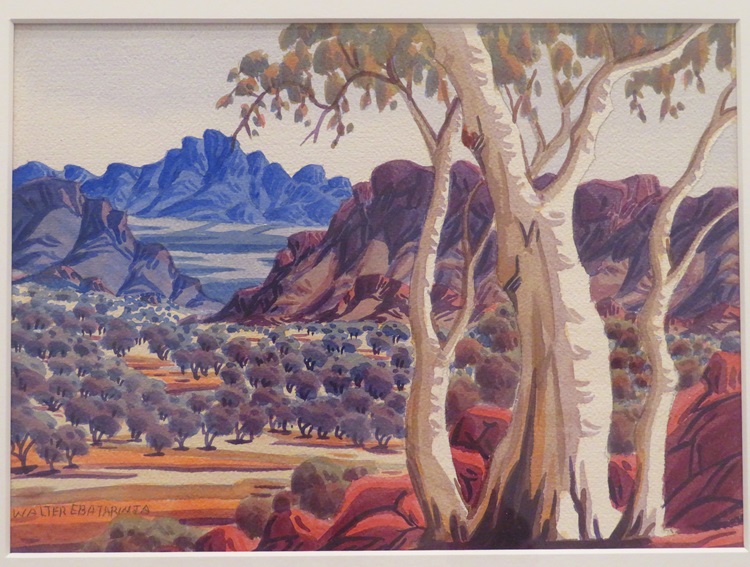
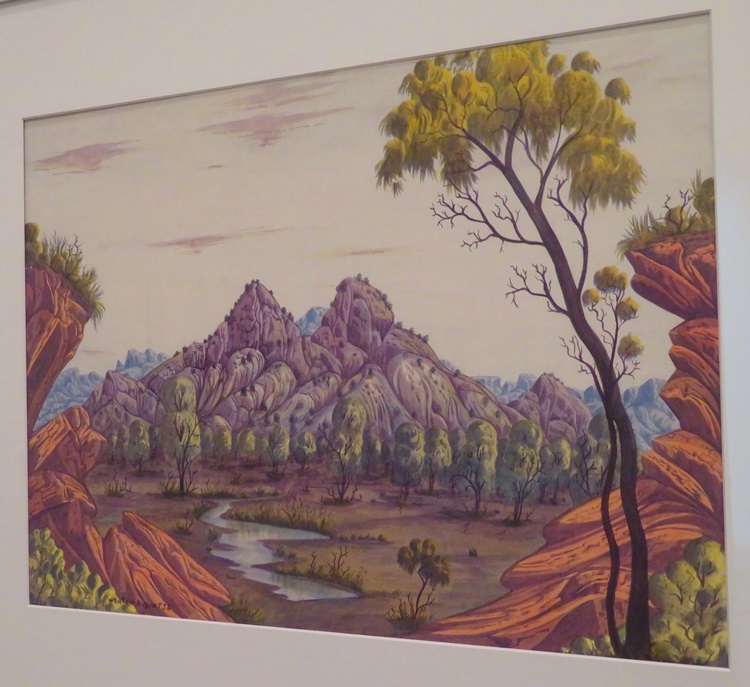
As the title of this exhibition suggests, this display features 100 watercolour works from artists connected to the Hermannsburg Mission and surrounding region. Unfortunately, in Australia’s colonial past, Aboriginal people were often relocated to religious missions for their care and education. While there are few good or happy stories to come out of those missions, Hermannsburg did create a community of artists and allowed artistic talent to flourish, bringing their talents to the World.
The beauty of this exhibition, other than all the striking artworks, is that it celebrates the extensive talents that flowed from this part of Central Australia. I was dazzled by the depth and breadth of watercolours produced by generations of Aboriginal artists – many from a broad and ancient family tree called Namatjira.

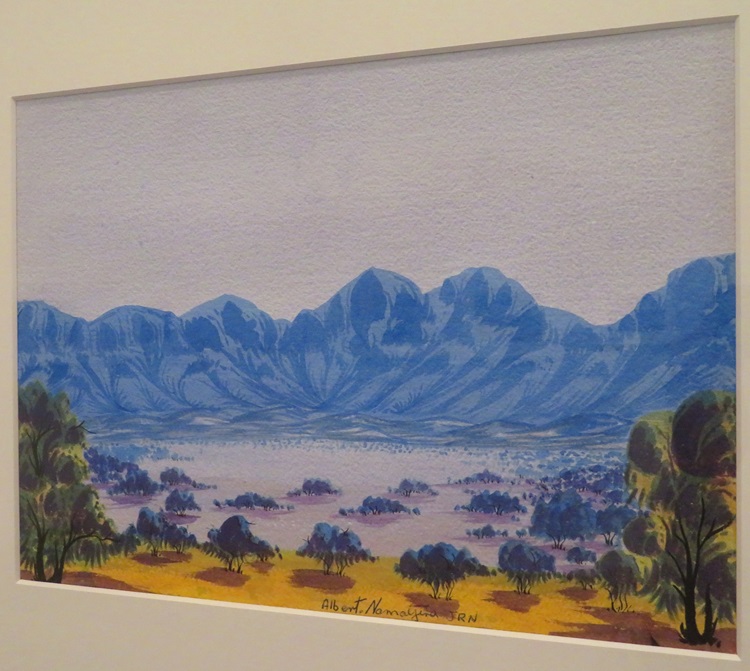


Albert Namatjira is probably the best-known watercolourist in this genre and style. I saw prints of his when I was a child and I suspect many older houses in Australia had a print or two of his hanging on the walls. Back then I did not believe that his colours were realistic, being so vivid and bright. It was only when I walked through some of this country in July 2023, that I realised he got it absolutely right.
‘You know, before I was an artist, all I ever saw were the tracks on the ground. We didn’t have time to look up at all. The tracks were our life, eyes down all the time. But now I see the beauty and it’s changed my life completely.’ – Albert Namatjira

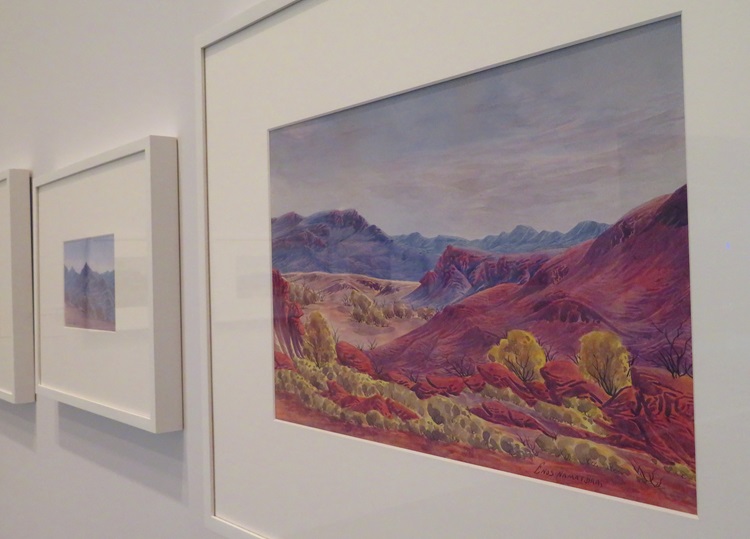
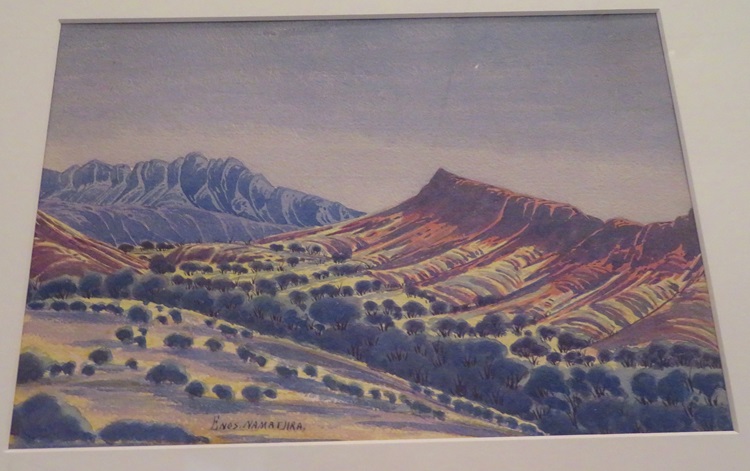
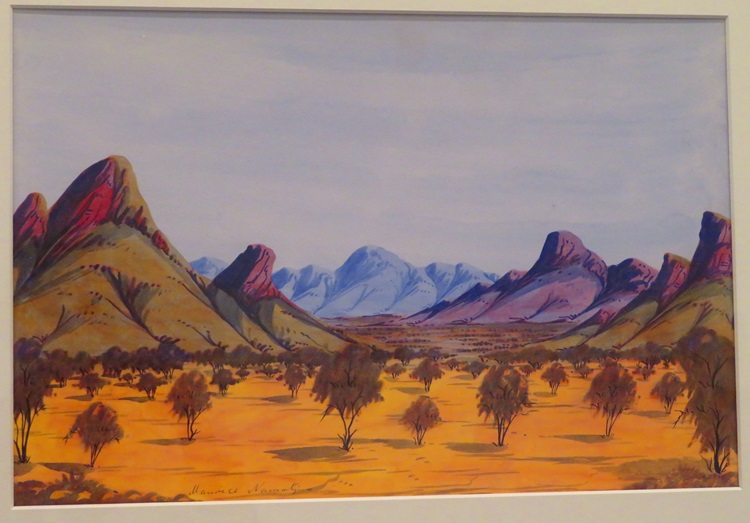
As I moved through the corridors of the exhibition my eyes were opened by the depth of talent in the Namatjira family. Many family members have a similar style and yet they put their own spin on the way they captured the landscape. I was also pleased to see that female artists were just as prominent and prolific as their male relations. (Apologies for the small feminist comment there, but often female artists do not achieve the same level of recognition or credibility.)
The really sad aspect of this exhibition was that for many artists, their lives were over far too soon. Even today, Aboriginal people have a shorter life expectancy than other Australians. While there have been improvements, we still have a long way to go before Aboriginal and Torres Strait Islander people enjoy the same sort of long and fulfilling life as I do. It is even sadder for these artists that their artistic journeys were cut way too short and their work was not truly acknowledged either creatively or financially until after their deaths.
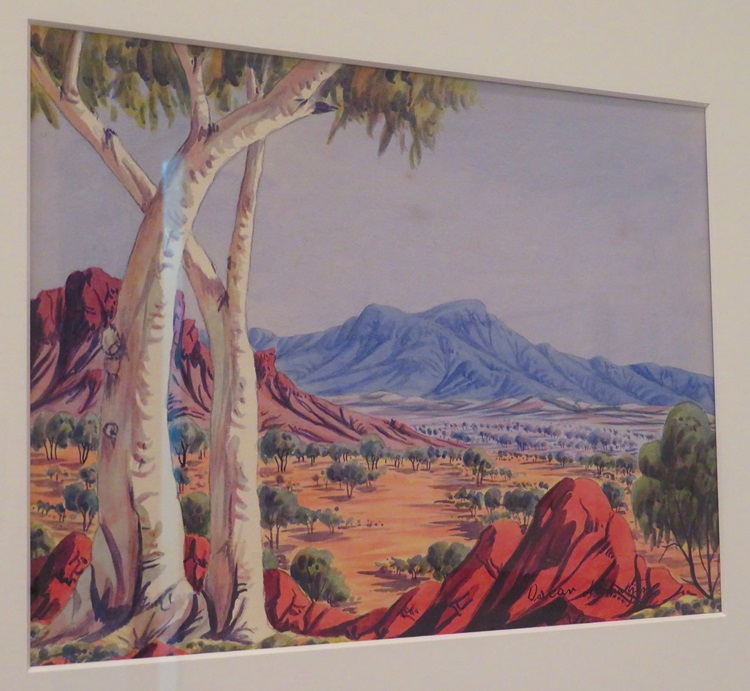


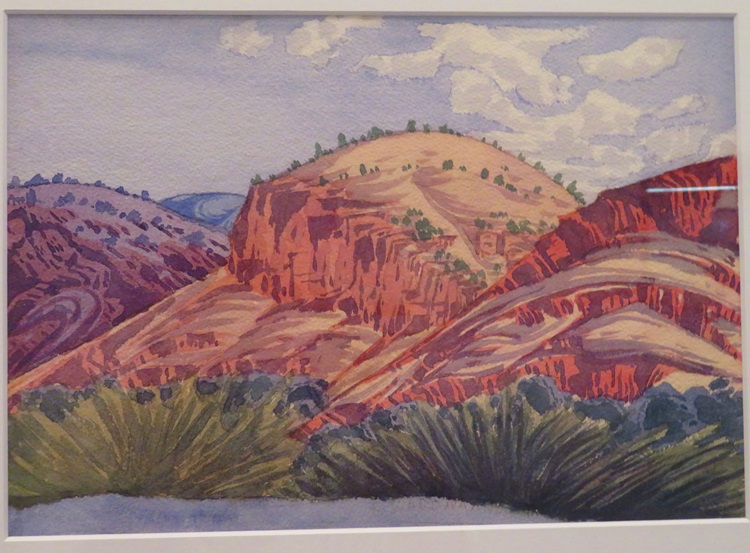
Having enjoyed the paintings and acknowledging the skill involved, I am not sure I would like this sort of artwork on my walls even if I could afford it. It’s not the style of artwork I could live with and that is how I judge whether I love a painting enough to buy it. Regardless of my budget and available wall space (very limited) none of these paintings were for sale so I could keep my wallet firmly tucked away.
I really enjoyed this exhibition as not only were the works skilful and beautiful, they brought back many happy memories of my time out on the Larapinta Trail. Some of the works featured Mt Sonder, the Finke River, Ormiston Gorge, Glen Helen Gorge and Standley Chasm. This exhibition is the perfect way to travel to and through Central Australia…without having to carry a backpack or break a sweat! 😊
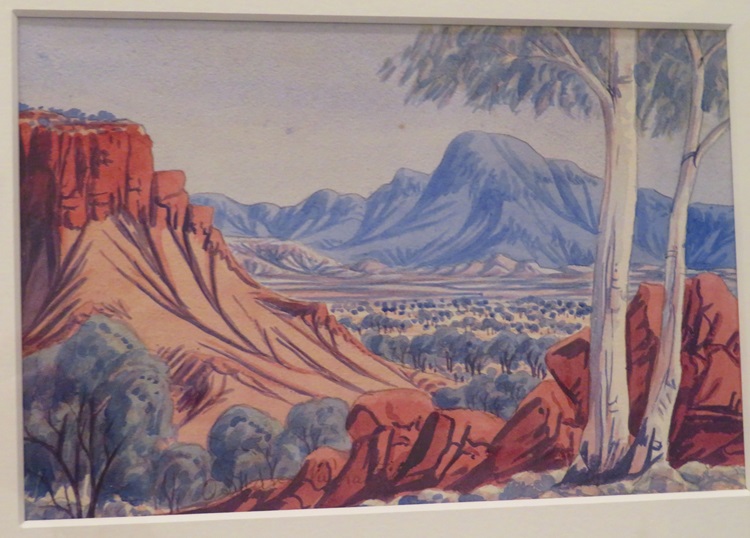
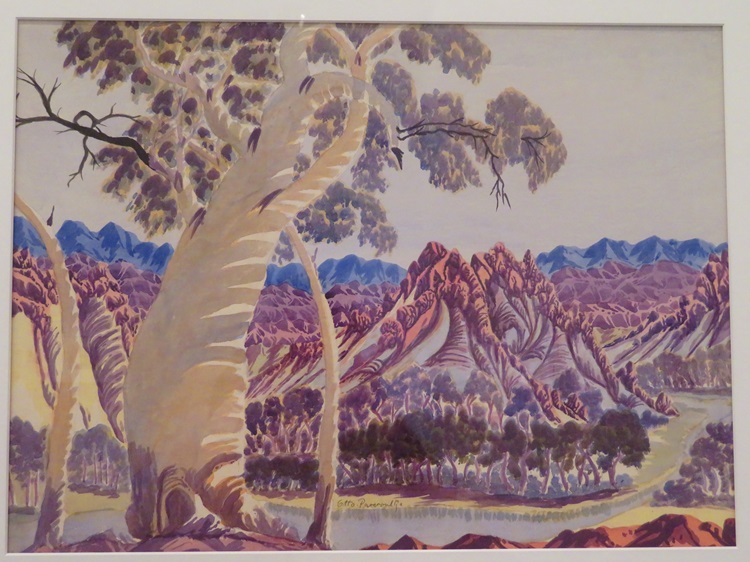


Overall, the Watercolour Country exhibition is a flawless way to immerse yourself in a unique painting style and an iconic Australian landscape. As it turned out, it also proved to be a mind-boggling contrast to another Indigenous art exhibition I wandered into immediately afterwards!
Watercolours? Oils? Pastels? What is your favourite artistic medium?
The Basics
What: The Ian Potter Gallery is a branch of the National Gallery of Victoria. As well as transfixing artworks, it has a large shop, café, and conducts regular free guided tours.
Where: Federation Square, Melbourne, adjacent to the ACMI centre.
When: The exhibition is open daily from 10am-5pm and closes on 14 April, 2024.

Why: To see artworks that showcase a unique part of Australia in a very unique way.
How: The NGV/Ian Potter Gallery is only a short walk from the centre of Melbourne and the Flinders Street Station.
Who: For art lovers and those passionate about the Australian Great Outdoors.
Related Posts: If you are tempted to head out into Central Australia and take a stroll along the Larapinta Trail, then this Tips and Tricks post may be useful.
Related Blogs: If you are interested in learning a little more about Albert Namatjira, there are endless links and profiles on the web. The Australian Museum has a good summary here.
Read About it: For a good insight into Central Australia and the cultural stories of its Aboriginal residents, have a look at Bruce Chatwin’s Songlines. It may be a little dated, but still a fascinating read.
#destinationvictoria #melbourne #travelinspo #ianpottergallery #NGV #freetours #federationsquare #watercolours #artexhibitions #painters #touristattraction #aboriginalartists #indigenousartists #art #hermannsburgmission #centralaustralianart #exhibitions #albertnamatjira


Very pretty, especially grouped in fours like you have on your site. I especially like the lone white tree bending over at the top.
LikeLiked by 1 person
They really captured the colours of the landscape and the sparseness of the landscape. Have a good day.
LikeLiked by 2 people
Wonderful artwork of the outback, there is something that draws me to to that desolate land. For the aboriginal people it is spiritual and obviously more. The treatment of their culture, their people and land has been atrocious. I am glad to see their artwork without the touristy cheapness attached to it. I would happily visit that exhibition. Thanks for sharing it, Mel.
LikeLiked by 1 person
My pleasure, Suzanne. And you used exactly the right word – desolate. I was searching just for that word a moment ago. Even though it is an incredibly rugged part of Aus, it is still beautiful.
LikeLiked by 1 person
It is beautiful and not so barren as people may think.
LikeLiked by 1 person
True – especially around all the watering holes in the chasms and gorges along the West MacDonnell Ranges.
LikeLiked by 1 person
When I wrote desolate it is comparable to the coastal strip of Australia 🙂 I hope your training is going well.
LikeLiked by 1 person
The only training I am doing at the moment is running around like a blue arse fly! 🙂
LikeLiked by 1 person
Hopefully I won’t swat you ,which of course, is unlikely 😉 Busy travelling around the countryside?
LikeLiked by 1 person
No, busy attending to family health matters. I am sure you can relate. x
LikeLike
I do, and look after yourself. Buckets and open spaces are wonderful places to scream in. Take care, Mel xx
LikeLiked by 1 person
Many thanks, Suzanne. x
LikeLiked by 1 person
I too lack artistic ability and am in awe of others who can create such images. Lovely paintings, thank you for taking us on this tour and providing some history and context to go along with it.
LikeLiked by 1 person
My pleasure. The colours of the paintings are as rich as Aboriginal history and culture. Thanks for reading, Diana.
LikeLiked by 1 person
I also have no artistic skills, both my brothers are artists and they took all of those genes. But through them I can appreciate artistic talents. These paintings are beautiful and capture the scenes so well. Maggie
LikeLiked by 1 person
There is a lady in my bushwalking club who sketches and paints as we walk! She is amazing. How good would it be to have that skill? Have a great day, Maggie
LikeLiked by 1 person
As you said, the colours are so vivid, Mel. These works really are beautiful. It’s a privilege to see them.
LikeLiked by 1 person
It was certainly a privilege and really opened my eyes to the depth and breadth of talent. Melx
LikeLiked by 1 person
That looks like a lovely collection. Thank you for the introduction.
LikeLiked by 2 people
My pleasure – thanks for dazzling me with your views of Nepal.
LikeLiked by 1 person
Again, my pleasure
LikeLiked by 1 person
What a lovely selection of watercolours which paint the landscape so well.
LikeLike
That’s some really stunning artwork.
LikeLiked by 1 person
Way, way, way above my skill level! 🙂
LikeLiked by 1 person
To be able to draw (or play an instrument for that matter) … it must be wonderful. Like you, I appreciate this – one can see the texture of the mountains on some of these paintings. I can understand why you loved strolling through the gallery – it must have felt to you like you were hiking the Larapinta Trail all over again (this time, without a drop of sweat on your forehead).
LikeLiked by 1 person
As you say, how wonderful to have a musical or creative talent! All I can do is walk a bit! 🙂
LikeLiked by 1 person
And not many people can do it like you do 😉!
LikeLiked by 1 person
You are very kind… 🙂
LikeLiked by 1 person